

Table of Contents
Tags
Share
“Our expenses are higher than ever, and we urgently need a solution.”
This sentiment has echoed across the corporate world more than ever over the past decade. Artificial Intelligence (AI) is now at the forefront of the race to cut down expenses, automate tasks, and boost revenue across all industries. If you’re worried about high development costs and whether artificial intelligence can benefit your business, this article from our AI consultants provides valuable insights to help you devise the right cost reduction strategy.
AI: Your Ticket To Cutting Costs in 2024
If you want to be competitive in 2024, you can no longer avoid optimizing your business through technology. That’s why organizations are constantly seeking innovative ways to use technology to improve efficiency and reduce costs. Not surprisingly, Artificial Intelligence is at the forefront of these advancements.
AI encompasses a broad spectrum of technologies that enable machines to mimic human cognitive functions such as learning, problem-solving, and decision-making. Machine Learning (ML), Natural Language Processing (NLP), and Intelligent Process Automation (IPA) are some prominent subsets of AI that organizations leverage to streamline processes and cut costs.
How Does AI Reduce Costs?
In short, AI saves you and your team time. There are a variety of mechanisms and applications across different sectors where AI comes in handy. Here are some key ways AI contributes to cost reduction.
Let the robots do the work
Harness AI for cost savings by automating tasks with AI-based solutions like Robotic Process Automation (RPA). These solutions streamline your workflows and take care of repetitive, rule-based activities such as data entry, invoice processing, and customer support. This eliminates the need for manual intervention, reduces errors, gets tasks completed faster, and allows your employees to focus on high-value work. Sometimes, you’ll find automation in unexpected places. For example, robots can even be used to digitize the purchase of student photos.
Solve problems before they get out of hand
AI-driven predictive maintenance solutions make it possible for businesses to anticipate equipment failures before they occur, thereby preventing costly downtime and unplanned maintenance. AI algorithms can identify patterns pointing to potential failures by analyzing historical data, sensor readings, and other relevant factors. This allows businesses the opportunity to schedule maintenance proactively. Such a predictive approach reduces overall operational costs by extending the lifespan of critical assets and optimizing maintenance schedules.
Meet your customers’ expectations
You can use AI to forecast demand, improve supply chain efficiency, manage your inventory, and reduce downtime through predictive maintenance. AI algorithms analyze historical data and sensor readings to identify failure patterns, enable proactive maintenance scheduling, extend asset lifespan, and reduce operational costs. As far as retail is concerned, Gartner predicts that 80% of customer service organizations will use generative AI for personalized experiences by 2025.
Boost sales with smart pricing
AI-powered pricing algorithms enable businesses to put in place dynamic pricing strategies based on real-time market conditions, customer behavior, and competitor analysis. By leveraging ML models, businesses can fine-tune prices dynamically to maximize revenue while staying highly competitive. Additionally, AI algorithms can identify pricing anomalies and detect instances of price gouging or revenue leakage, which further enhances profitability. What is clear is that industries, such as retail, will never be the same again. Read more on that here.
Keep costs down and sustainability up
AI-based management systems optimize energy consumption by analyzing historical data such as weather patterns and building occupancy. This helps businesses to cut costs, enhance their operational efficiency, and boost their overall sustainability. These AI-driven energy management solutions also identify opportunities for energy conservation, from adjusting HVAC settings to scheduling equipment more efficiently. This again results in substantial cost savings and improved sustainability.
Your new customer service superheroes
AI-driven chatbots and virtual assistants revolutionize customer service by automating routine inquiries and support. NLP algorithms ensure accurate and efficient real-time handling of customer queries, which can reduce staffing costs while improving customer satisfaction levels.
AI is transforming the business landscape.
Make it work for you.
More Than Just Cutting Costs
The adoption of AI for cost optimization offers numerous benefits to organizations across various industries:
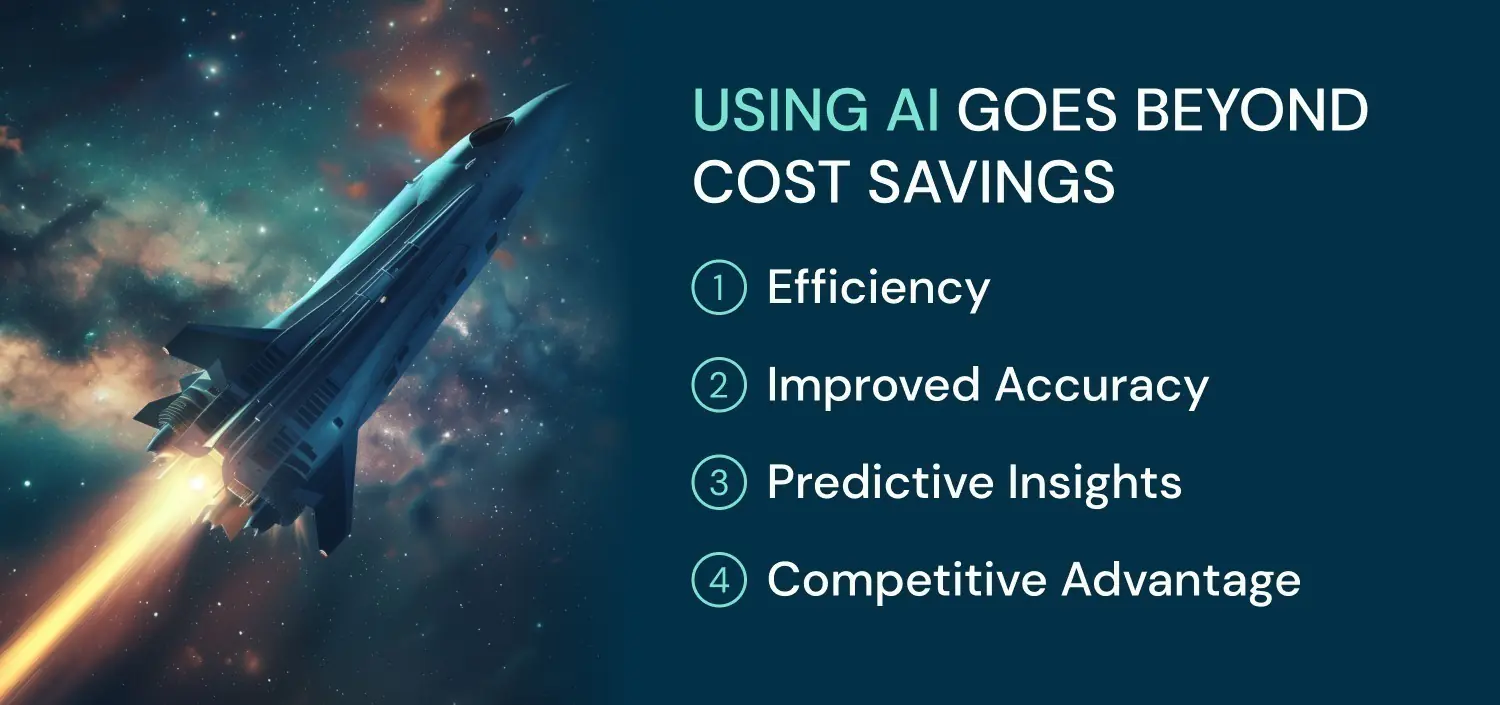
Efficiency
By automating repetitive tasks and optimizing processes, AI enables organizations to operate more efficiently by minimizing resource wastage and improving productivity.
Improved Accuracy
We all make mistakes. AI limits human errors since AI algorithms are capable of processing vast amounts of data with unprecedented accuracy, which minimizes errors and the risk of costly mistakes.
Predictive Insights
AI-powered analytics provide valuable predictive insights, enabling proactive decision-making and risk mitigation, thereby avoiding potential losses.
Competitive Advantage
Organizations that harness AI for cost optimization gain a competitive edge by offering better products or services at competitive prices, which results in a satisfied and loyal customer base.
AI-driven solutions lead to cost reduction by minimizing operational expenses, reducing human errors, and optimizing resource utilization. Leading tech giants like Alibaba and Amazon vie for global AI leadership, translating innovations into enhanced product listings and engaging user experiences for customers worldwide.
AI for Cost Savings: Tips for Making It Work
While the AI cost reduction potential is enormous, you need a solid AI implementation strategy to succeed in your endeavour. Here are some best practices to consider:
Identify Key Areas for Optimization
Conduct a comprehensive assessment of your operations to identify areas where AI can effect cost savings.
Assess Current Infrastructure
Implementing AI in an organization is not always easy, especially if a company still relies on legacy systems. According to the World Retail Banking Report 2022, 95% of top global banking executives named outdated legacy systems and core banking platforms as major obstacles to their efforts to optimize data.
Data Quality and Accessibility
Make sure that the AI algorithms have access to high-quality, relevant data to deliver accurate insights and recommendations. Invest in data governance practices to maintain data integrity and security.
Collaborative Approach
For AI to reduce costs, it’s best to initiate collaboration with your team before implementation. Discuss the process with business stakeholders, data scientists, and IT professionals to ensure alignment between AI initiatives and organizational goals. Encourage cross-functional teamwork to drive successful AI adoption.
Scalability and Flexibility
Select AI solutions that are scalable and adaptable to accommodate evolving business requirements and changing market dynamics.
Choose platforms and technologies that can seamlessly integrate with existing systems and workflows.
Continuous Monitoring and Optimization
Implement mechanisms for constant monitoring and optimization of AI-driven processes to ensure they remain effective over time.
Regularly review performance metrics, refine algorithms, and incorporate feedback to drive continuous improvement.
Still Need Convincing? The Numbers Don’t Lie
Here are just a few numbers that illustrate how AI adoption is changing the business landscape.
Overall Adoption Rate
According to Gartner, by 2026, more than 80% of enterprises will have used generative AI APIs or deployed generative AI-enabled applications.
A survey by McKinsey found that more than 40% of executives reported that their organizations will increase their investment in AI.
Investment Trends
Gartner Predicts AI Software Will Grow To $297 Billion By 2027.
Industry Adoption
In healthcare, the global AI healthcare market is valued at USD 20.9 billion and is expected to reach USD 148.4 billion by 2029 (CAGR)
According to a PwC survey, 54% of organizations report that their company has implemented generative AI.
Impact on Business Operations
Deloitte reports that 82% of early AI adopters have seen a positive return on investment (ROI) from their AI initiatives.
Job Market Trends
LinkedIn identified AI as one of the top emerging jobs, with an astonishing growth of 140.88% year-over-year between 2023 and 2024.
Despite concerns about job displacement, a report by the World Economic Forum suggests that AI may replace around 85 million jobs by 2025 whilst creating approximately 97 million new roles.
Challenges and Concerns
McKinsey’s recent survey shows that, while not as big of a challenge as in previous years, hiring for AI roles (particularly machine learning engineers) remains a challenge.
According to Deloitte, data security and privacy concerns remain significant, with 22% of respondents identifying data privacy and security as their top concern regarding AI adoption.
Watch Your Business Costs Plummet
Cost efficiency comes with a price, but it’s worth it! AI implementation costs vary, from a few hundred dollars to six figures, depending on your optimization goals. In US healthcare spending, AI adoption promises 5-10% annual savings, totaling $200-$360 billion.
Plan, communicate, involve stakeholders. The global AI market is set to grow from $2.5B in 2020 to $19.6B by 2025. AI opens doors to efficiency gains, cost reduction, and a competitive advantage. If you haven’t started your AI transformation, get on to it right now. It’s never too late to cut costs!
Author: Exadel AI Team